
Recourse vs Non-Recourse Factoring: What Is the Difference?
Recourse vs Non-Recourse Factoring: What Is the Difference?
When you sell unpaid invoices to a factoring company, one of the most important terms in your agreement is what happens if your customer never pays. That single detail defines whether you have a recourse or non-recourse factoring arrangement.
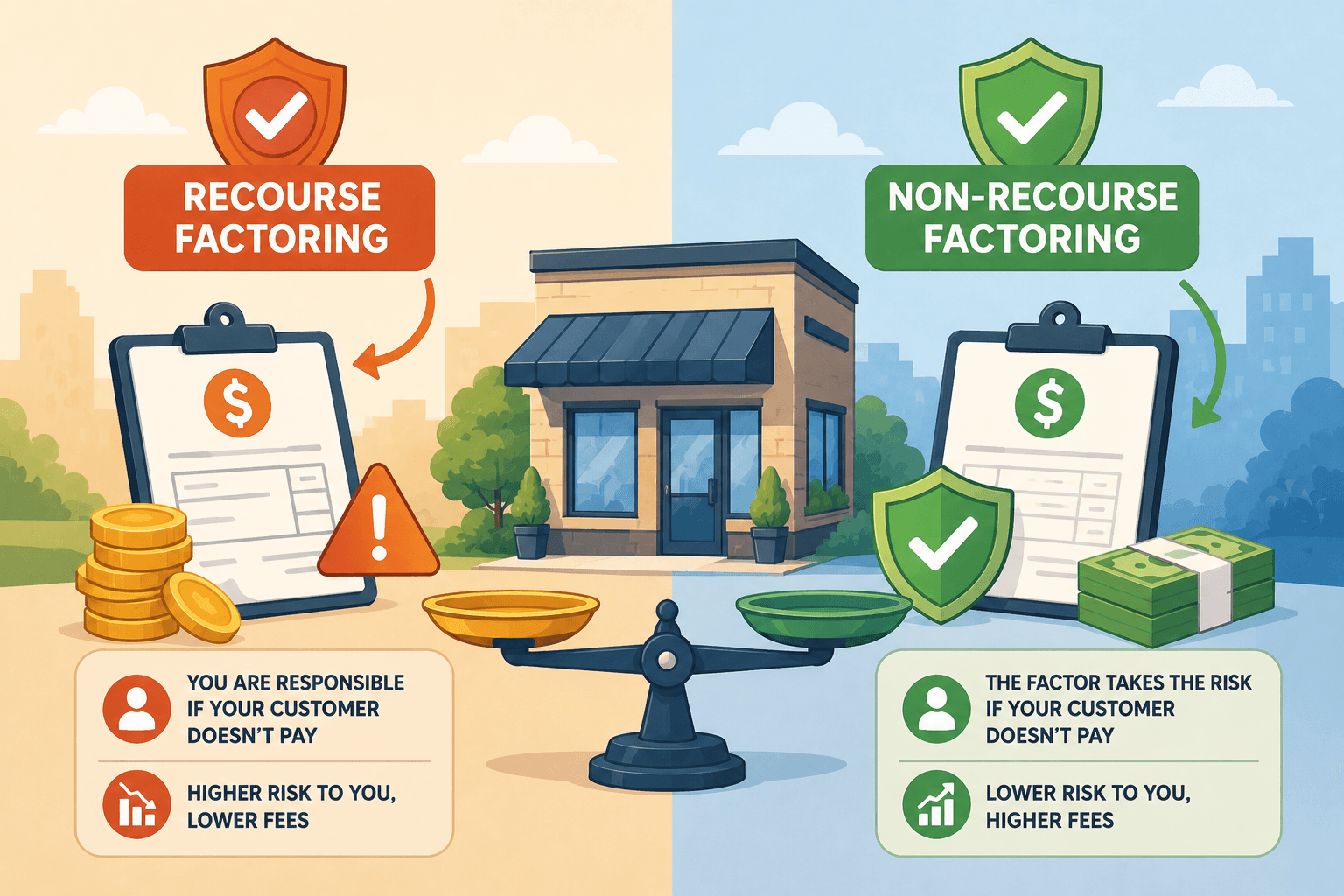
The core difference between recourse vs non-recourse factoring comes down to risk. With recourse factoring, your business is on the hook if the customer does not pay. With non-recourse factoring, the factoring company absorbs certain credit risks instead. Understanding how each structure works will help you choose the right option for your cash flow needs and risk tolerance.
What Is Invoice Factoring?
Invoice factoring is a financing method where a business sells its outstanding invoices to a factoring company at a discount. In return, the business receives immediate cash, typically a large percentage of the invoice value upfront, with the remainder (minus fees) paid after the customer settles the invoice.
Factoring is not a loan. You are selling an asset (your receivable), not borrowing against it. This makes it accessible to businesses that may not qualify for traditional financing. If you want a deeper explanation, read our guide on What Is Invoice Factoring?.
The factoring company then collects payment directly from your customer. But the question remains: what happens if your customer does not pay? That is where recourse and non-recourse structures diverge.
What Is Recourse Factoring?
Recourse factoring means your business retains liability for invoices that go unpaid. If the factoring company cannot collect from your customer, the responsibility falls back on you.
In practical terms, the factoring company can require you to:
- Buy back the unpaid invoice at its full face value
- Replace it with another invoice of equal or greater value
- Accept a deduction from your reserve account
The recourse clause typically kicks in after a set window, often 60 to 120 days past the invoice due date. It can also be triggered if the customer becomes insolvent, files for bankruptcy, or disputes the invoice.
Recourse factoring is the most common type of factoring arrangement. Because the factoring company shares less risk, this structure is widely available and comes with lower fees.
Pros and Cons of Recourse Factoring
Pros:
- Lower factoring fees compared to non-recourse agreements
- Easier to qualify for, since the factoring company has less exposure
- More factoring companies offer recourse arrangements, giving you more options
- Broader range of invoices may be accepted
Cons:
- Your business carries the credit risk if customers fail to pay
- Potential financial liability if a customer becomes insolvent
- You may need to maintain a reserve account as a buffer against unpaid invoices
- Cash flow disruption if you are required to buy back an invoice unexpectedly
What Is Non-Recourse Factoring?
Non-recourse factoring shifts certain credit risks from your business to the factoring company. If a customer cannot pay due to a specific covered event, the factoring company absorbs the loss instead of requiring you to buy back the invoice.
However, there is a common misconception worth clearing up: non-recourse factoring does not mean zero risk for your business. Most non-recourse agreements only cover a narrow set of triggers, typically customer insolvency or bankruptcy. If your customer simply refuses to pay because of a dispute over goods or services, or if they just pay late and then default for reasons outside the covered triggers, you may still be responsible.
Always read the non-recourse clause carefully. The specific covered events vary by factoring company, and the scope of protection may be narrower than you expect.
Pros and Cons of Non-Recourse Factoring
Pros:
- Reduced credit risk exposure for your business
- Protection if a customer files for bankruptcy or becomes insolvent
- Can be valuable when working with customers whose financial stability is uncertain
- Simplifies bad debt planning
Cons:
- Higher factoring fees to compensate for the factoring company's increased risk
- Stricter eligibility requirements; the factoring company will scrutinize your customers' creditworthiness more closely
- Coverage scope is limited to specific triggers, not all forms of non-payment
- Fewer factoring companies offer true non-recourse arrangements
Recourse vs Non-Recourse Factoring: Side-by-Side Comparison
| Feature | Recourse Factoring | Non-Recourse Factoring |
|---|---|---|
| Credit risk | Business retains risk | Factoring company assumes risk for covered events |
| Typical fees | Generally lower | Generally higher |
| Qualification difficulty | Easier to qualify | Stricter requirements |
| Availability | Widely available | Less common |
| Coverage scope | N/A (risk stays with business) | Limited to specific triggers (e.g., customer insolvency) |
| Ideal use case | Businesses with creditworthy customers seeking lower costs | Businesses wanting to offload credit risk despite higher fees |
Fee structures vary by factoring company, invoice volume, customer credit profiles, and industry. For more context on pricing, see How Much Does Invoice Factoring Cost?.
Which Type of Factoring Is Right for Your Business?
The right choice depends on your customer base, risk tolerance, and margins.
Recourse factoring may be a better fit if:
- Your customers have strong credit histories and reliable payment records
- You want to keep factoring fees as low as possible
- Your profit margins are tight and every percentage point matters
- You are comfortable managing the risk of occasional non-payment
Non-recourse factoring may be a better fit if:
- You work with customers whose financial stability is hard to predict
- You want to protect your business against the impact of a major customer going bankrupt
- You are willing to pay higher fees in exchange for reduced risk exposure
- Your industry has historically higher rates of customer default
Industry context matters too. Trucking companies, staffing agencies, and construction firms all use factoring heavily, but their risk profiles differ. A staffing agency placing workers with a single large client may want non-recourse protection against that client's potential insolvency. A trucking company with dozens of brokers may prefer recourse factoring to keep costs down.
For industry-specific guidance, explore these resources:
- Invoice Factoring for Trucking Companies
- Invoice Factoring for Staffing Agencies
- Invoice Factoring for Construction Companies
Key Questions to Ask a Factoring Company
Before signing any factoring agreement, ask these questions to understand exactly what you are agreeing to:
- What events trigger the recourse clause? Get a clear list of scenarios where you would be required to buy back an invoice.
- What is the recourse period? Know how many days past the due date the factoring company will wait before invoking recourse.
- For non-recourse agreements, what specific events are covered? Confirm whether coverage is limited to insolvency or extends to other situations like disputes.
- What are the fee differences between recourse and non-recourse options? Ask for a direct comparison so you can weigh the cost of risk transfer.
- Are there reserve holdbacks? Many factoring companies hold a percentage of each invoice in reserve. Understand when and how that reserve is released.
- How does the factoring company evaluate my customers? Understanding their credit review process helps you anticipate which invoices will be accepted.
BreadRoute is a marketplace that helps small business owners compare factoring companies and other financing options side by side. You can explore multiple offers without committing to a single provider.
Other Ways to Manage Cash Flow
Factoring is one tool in a broader cash flow toolkit. Depending on your situation, other financing options may also be worth exploring:
- Business line of credit: Draw funds as needed and pay interest only on what you use. Learn more in What Is a Business Line of Credit?.
- Accounts receivable financing: Use your receivables as collateral for a loan or credit facility rather than selling them outright. See What Is Accounts Receivable Financing? or visit our Accounts Receivable Financing page.
- Working capital financing: Access funds to cover day-to-day operational expenses. Read What Is Working Capital Financing?.
For a broader look at managing business cash flow, check out Cash Flow Management for Small Business.
Compare Factoring Options Through BreadRoute
Choosing between recourse and non-recourse factoring is easier when you can compare multiple factoring companies in one place. BreadRoute connects small business owners with factoring providers and other financing options so you can evaluate terms, fees, and structures side by side.
Whether you are looking for Invoice Factoring or exploring other financing paths, BreadRoute can help you find options that fit your business.
This article provides general information and should not be considered financial or insurance advice.
Frequently Asked Questions
The main difference is who bears the risk when a customer does not pay. With recourse factoring, your business is responsible for unpaid invoices and may need to buy them back. With non-recourse factoring, the factoring company absorbs the loss for specific covered events, typically customer insolvency or bankruptcy.
No. Most non-recourse agreements only cover specific triggers such as customer bankruptcy or insolvency. If a customer refuses to pay because of a dispute or simply delays payment indefinitely for other reasons, you may still be liable. Always review the exact terms of coverage in your agreement.
Recourse factoring is significantly more common. Because the business retains the credit risk, factoring companies face less exposure, which makes recourse arrangements easier to offer and qualify for. The majority of factoring agreements in the market are recourse-based.
Non-recourse factoring generally carries higher fees because the factoring company is taking on more risk. The exact difference varies depending on the factoring provider, your invoice volume, and the creditworthiness of your customers. Ask prospective factoring companies for a side-by-side fee comparison.
The factoring company will typically attempt to collect from your customer for a set period (often 60 to 120 days past the due date). If the customer still has not paid after that window, the factoring company can require you to buy back the invoice, replace it with another eligible invoice, or deduct the amount from your reserve.
In some cases, yes. Some factoring companies offer both structures and may allow you to transition. However, switching to non-recourse will likely come with higher fees and stricter requirements around your customers' credit profiles. Discuss your options directly with the factoring company.
Non-recourse factoring is used across various industries, but it is particularly common in sectors where businesses work with a small number of large clients and want protection against a single client default. Examples include staffing, transportation, and manufacturing. That said, availability depends on the factoring company and the creditworthiness of your customers.
Factoring companies typically run credit checks on your customers rather than on your business. They review factors such as payment history, credit scores, financial stability, and industry risk. For non-recourse agreements, this evaluation is more thorough because the factoring company is accepting greater risk.