
Section 179 and Equipment Financing: A Small Business Guide
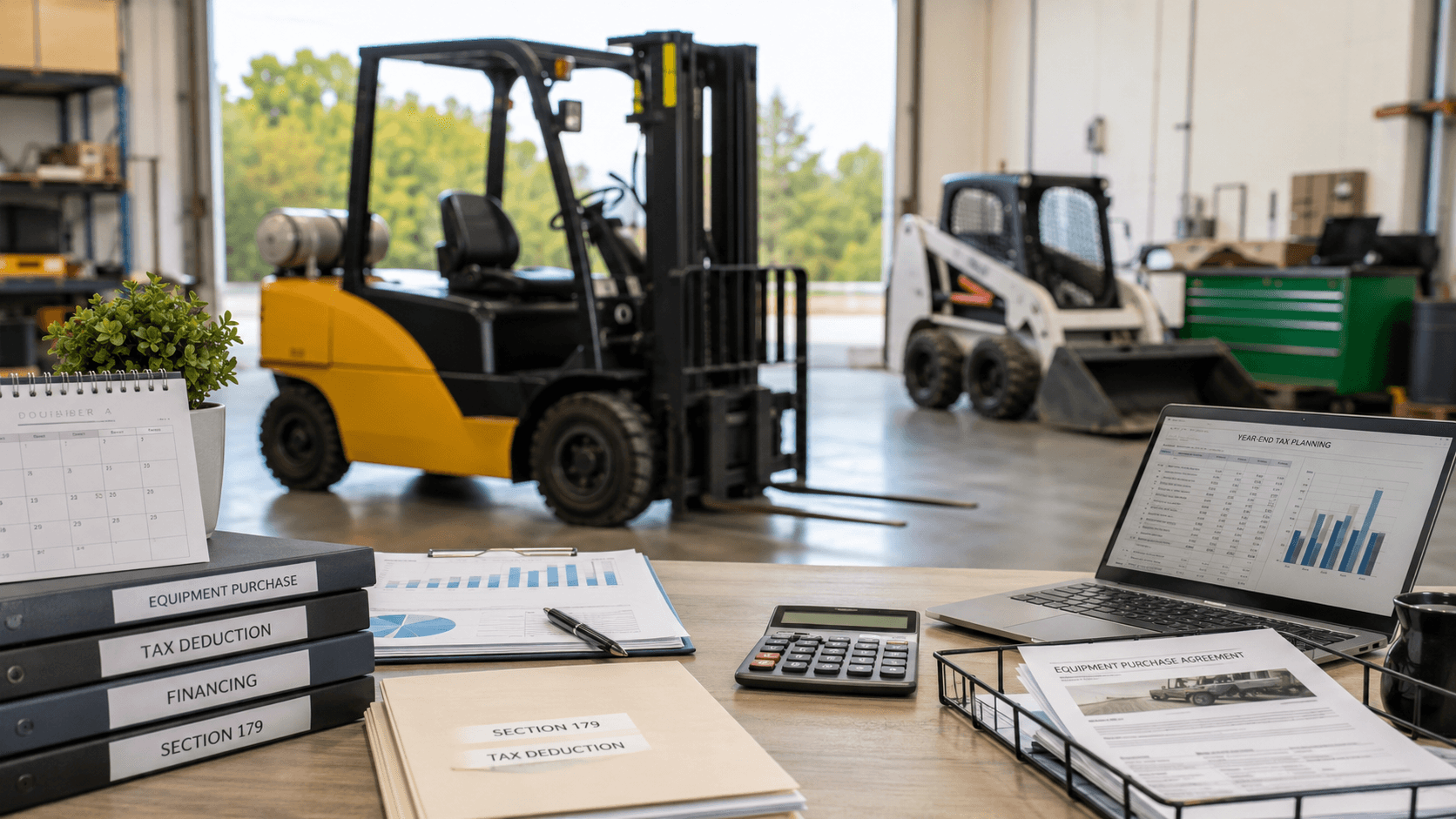
Section 179 and Equipment Financing: A Small Business Guide
Buying equipment is one of the largest capital decisions a small business makes. Section 179 of the Internal Revenue Code offers a meaningful tax incentive: it lets you deduct the full purchase price of qualifying equipment in the year you place it in service, rather than spreading that deduction across multiple years through standard depreciation.
Here is where it gets practical. You do not have to pay for equipment in full to claim the deduction. When you finance an equipment purchase, you can still take the Section 179 deduction for the total purchase price, even though you are making payments over time. That combination of a tax deduction and manageable monthly payments can help preserve cash flow while still investing in the assets your business needs.
This guide explains how Section 179 and equipment financing work together, what qualifies, and how to time your purchases. It is not tax advice. Always consult a CPA or tax professional for guidance specific to your situation.
What Is the Section 179 Deduction?
Section 179 is a provision in the U.S. tax code that allows businesses to deduct the full cost of qualifying equipment and software in the tax year the asset is purchased and placed in service. Without Section 179, businesses would typically depreciate equipment over its useful life, spreading the tax benefit across several years.
For tax year 2025, the Section 179 deduction limit was $1,250,000, with a total equipment spending cap of $3,130,000 before the deduction begins to phase out. These limits are adjusted annually for inflation. Before claiming the deduction for the current tax year, verify the updated figures directly with the IRS or your tax professional.
A few important points to understand:
- Section 179 is a tax code provision, not a financing product.
- The deduction applies to the purchase price of the equipment, not to interest or financing charges.
- Your business must have taxable income to use the deduction (you cannot use Section 179 to create or increase a net operating loss).
How Section 179 Works with Equipment Financing
This is the key concept for small business owners evaluating their options. When you finance equipment through a loan or equipment financing agreement, the IRS generally treats you as the owner of that equipment for tax purposes. That means you can claim the full Section 179 deduction on the purchase price, even though you have not paid the entire amount yet.
Consider this simplified example:
- Your business finances $100,000 worth of manufacturing equipment in August.
- You make a 10% down payment ($10,000) and finance the remaining $90,000.
- By the end of the tax year, you have made roughly $15,000 in total payments (down payment plus monthly installments).
- You can still deduct the full $100,000 purchase price under Section 179 for that tax year, assuming the equipment qualifies and your business meets the eligibility requirements.
The result: you invest $15,000 out of pocket in year one, but you receive a tax deduction on the full $100,000 purchase price. The actual tax savings depend on your effective tax rate and overall tax situation.
This is one reason equipment financing is a popular strategy for businesses looking to grow while managing cash flow. For a broader overview of how equipment financing works, read our equipment financing guide.
Always confirm with a tax advisor that your specific financing arrangement qualifies for Section 179.
Section 179 vs. Bonus Depreciation
Section 179 is not the only accelerated depreciation option available. Bonus depreciation is another provision that lets businesses deduct a percentage of an asset's cost in the first year. Understanding how these two provisions differ can help you and your tax advisor develop a smarter strategy.
Section 179:
- Has an annual deduction limit (adjusted for inflation each year).
- Has a total spending cap, above which the deduction phases out dollar-for-dollar.
- Cannot be used to create a net operating loss.
- Applies to new and used equipment (as long as it is new to your business).
Bonus Depreciation:
- Has been phasing down in recent years. For 2025, the bonus depreciation rate was 40%, down from 60% in 2024 and 80% in 2023. Verify the current-year percentage with a CPA.
- No deduction cap or spending limit.
- Can be used to create a net operating loss.
- Applies to the remaining depreciable cost after Section 179 has been applied, or can be used independently.
In some cases, businesses can use both provisions on the same asset. For example, you might apply Section 179 up to the deduction limit and then use bonus depreciation on any remaining cost. The right approach depends on your tax situation, so work with a qualified tax professional to determine what combination makes sense.
What Equipment Qualifies for Section 179?
Not every business purchase qualifies. Here are the general categories of assets that are typically eligible for the Section 179 deduction:
- Machinery and manufacturing equipment
- Computers, printers, and related technology
- Business software (off-the-shelf, not custom-developed)
- Office furniture and fixtures
- Vehicles used for business purposes (subject to weight limits and SUV deduction caps)
- Certain building improvements, including HVAC systems, fire suppression, alarm and security systems, and roofing
What generally does not qualify:
- Real property (land and most buildings)
- Equipment used for personal purposes more than 50% of the time
- Property acquired from a related party
- Inventory or stock in trade
For industry-specific examples, our guides on restaurant equipment financing and how to get equipment financing for your restaurant cover qualifying equipment in the food service space.
Deduction Limits and Phase-Out Thresholds
Section 179 deduction limits change annually. Here are the figures for recent tax years to illustrate the trend. Always verify the current-year numbers before making purchase decisions.
| Tax Year | Maximum Deduction | Spending Cap (Phase-Out Begins) |
|---|---|---|
| 2023 | $1,160,000 | $2,890,000 |
| 2024 | $1,220,000 | $3,050,000 |
| 2025 | $1,250,000 | $3,130,000 |
| 2026 | TBD (adjusted for inflation) | TBD |
Once your total equipment purchases exceed the spending cap, the deduction decreases dollar-for-dollar. If your total purchases exceed the cap by more than the maximum deduction amount, the Section 179 deduction is eliminated entirely for that year.
For SUVs over 6,000 pounds gross vehicle weight, there is a separate deduction cap (which was $30,500 for 2025). Lighter passenger vehicles have lower limits under standard depreciation rules.
Use our calculators page to help estimate financing costs, and consult your CPA for the tax-side calculations.
Timing Your Equipment Purchase and Financing
To qualify for Section 179 in a given tax year, the equipment must be both purchased and placed in service by December 31 of that year. "Placed in service" means the equipment is installed, set up, and ready for use in your business operations.
Here are practical timing considerations:
- Start early in the year. Ordering equipment in Q1 or Q2 gives you a buffer for manufacturing lead times, shipping delays, and installation.
- Account for delivery timelines. Large or custom equipment can take weeks or months to arrive. If you order in November, there is a real risk it will not be placed in service before year-end.
- Get financing in place before you order. Approval and documentation can take time. Applying for equipment financing early in the process reduces the chance of delays.
- Do not rush a purchase just for the deduction. The tax benefit is valuable, but only if the equipment purchase makes business sense on its own merits.
If you are considering financing alongside other funding needs, our small business financing guide provides a broader overview of your options.
Equipment Financing Options to Consider
Several financing structures pair well with the Section 179 deduction. The key requirement is that the financing arrangement must result in your business owning the equipment (or being treated as the owner for tax purposes).
- Equipment loans: You borrow a set amount to purchase equipment. The equipment serves as collateral. You own the asset from day one, which typically qualifies for Section 179.
- Equipment financing agreements (EFAs): Similar to equipment loans, EFAs let you acquire equipment with a structured repayment plan. Ownership is established at purchase.
- SBA loans for equipment: SBA 7(a) and SBA 504 loans can be used for equipment purchases. These government-backed loans often offer favorable terms. Learn more about SBA loan options.
- Leases: This is where it gets nuanced. A capital lease (also called a finance lease), where your business takes ownership at the end of the lease term, may qualify for Section 179. An operating lease, where you return the equipment at the end, generally does not. Read our comparison of equipment financing vs. leasing for more detail.
BreadRoute is a financing marketplace that connects small businesses with lenders offering equipment financing. We are not a lender ourselves, but we can help you find options that fit your needs. If your credit history is a concern, our guide on equipment financing with bad credit covers what to expect.
Example: Calculating Your Potential Tax Savings
Let's walk through a hypothetical to show how Section 179 and equipment financing can work together.
Scenario:
- A construction company finances $150,000 in new excavation equipment.
- The company puts 15% down ($22,500) and finances the remaining $127,500 over 5 years.
- The equipment is delivered and placed in service in September.
- The company's effective tax rate is 25% (this is hypothetical and will vary).
Section 179 deduction: $150,000 (the full purchase price, assuming the company is within the deduction and spending limits).
Estimated tax savings: $150,000 x 25% = $37,500 in reduced tax liability for the year.
Cash outlay in year one: The down payment plus several months of loan payments, likely in the range of $30,000 to $40,000, depending on the loan terms.
In this example, the estimated tax savings roughly offset the first-year cash outlay. The business gets the equipment it needs, claims a significant deduction, and spreads the remaining cost over time.
This is a simplified illustration. Actual tax savings depend on your business's total income, tax bracket, state taxes, and other factors. A CPA can model the exact impact for your situation.
Common Mistakes to Avoid
Small business owners sometimes lose out on the Section 179 deduction or run into problems because of avoidable errors. Watch for these:
- Assuming all leases qualify. Only capital leases (where you take ownership) typically qualify. Operating leases usually do not. Confirm the lease structure before counting on the deduction.
- Missing the placed-in-service deadline. Equipment ordered in December may not arrive or be installed before year-end. Plan ahead.
- Exceeding the spending cap. If your total equipment purchases exceed the phase-out threshold, your deduction shrinks or disappears. Track your spending totals.
- Not keeping proper documentation. Maintain purchase agreements, financing documents, delivery receipts, and records showing when equipment was placed in service.
- Confusing Section 179 with standard depreciation. Section 179 is an election. You have to actively claim it on your tax return (IRS Form 4562). It does not happen automatically.
- Forgetting the business-use requirement. Equipment must be used for business purposes more than 50% of the time to qualify.
Consult a Tax Professional
BreadRoute is a financing marketplace. We connect small businesses with lenders. We are not a tax advisor, CPA firm, or accounting service.
The information in this guide is intended to help you understand how Section 179 and equipment financing can work together. It is not a substitute for professional tax advice. Tax laws change, deduction limits shift, and every business has a unique financial situation.
Before making equipment purchase decisions based on the Section 179 deduction, work with a qualified CPA or tax professional who can review your specific circumstances and help you develop the right strategy.
Next Steps: Explore Equipment Financing Through BreadRoute
BreadRoute connects small businesses with equipment financing lenders across a range of industries and credit profiles. Whether you are purchasing machinery, vehicles, technology, or specialized tools, our marketplace can help you find financing options to consider. Pair your equipment purchase with the Section 179 deduction, and you may be able to invest in growth while managing your tax liability and cash flow.
This article provides general information and should not be considered financial or insurance advice. Section 179 rules, deduction limits, and bonus depreciation percentages change from year to year. Always consult a qualified CPA or tax professional before making tax-related decisions. BreadRoute is a financing marketplace, not a lender or tax advisor.
Frequently Asked Questions
Yes, in most cases. When you finance equipment through a loan or equipment financing agreement, the IRS generally treats you as the owner of that asset. That means you can typically claim the full Section 179 deduction on the purchase price, even though you are making payments over time. Confirm your specific financing structure qualifies with a tax professional.
Section 179 deduction limits are adjusted annually for inflation. For tax year 2025, the limit was $1,250,000. The 2026 limit has not yet been finalized as of this writing. Check the IRS website or consult your CPA for the most current figures before making purchase decisions.
It depends on the type of lease. A capital lease (also called a finance lease), where your business takes ownership of the equipment at the end of the lease term, may qualify for Section 179. An operating lease, where you return the equipment, generally does not. Review the lease terms carefully and consult a tax advisor.
Section 179 lets you deduct up to a set dollar limit of qualifying equipment costs in the purchase year, but it cannot create a net operating loss. Bonus depreciation allows you to deduct a percentage of the cost with no dollar cap and can create a loss. Bonus depreciation has been phasing down in recent years. Businesses can sometimes use both on the same asset. Consult a CPA for the current bonus depreciation rate.
No. Section 179 applies to both new and used equipment, as long as the equipment is new to your business. If you purchase a used piece of machinery that you have not previously owned, it can qualify. The asset must be purchased (not gifted) and used for business purposes more than 50% of the time.
The equipment must be purchased and placed in service by December 31 of the tax year in which you want to claim the deduction. "Placed in service" means the equipment is installed, operational, and available for use in your business. Simply ordering or paying for the equipment is not sufficient if it has not been set up and ready for use by year-end.